
 alhodhodnews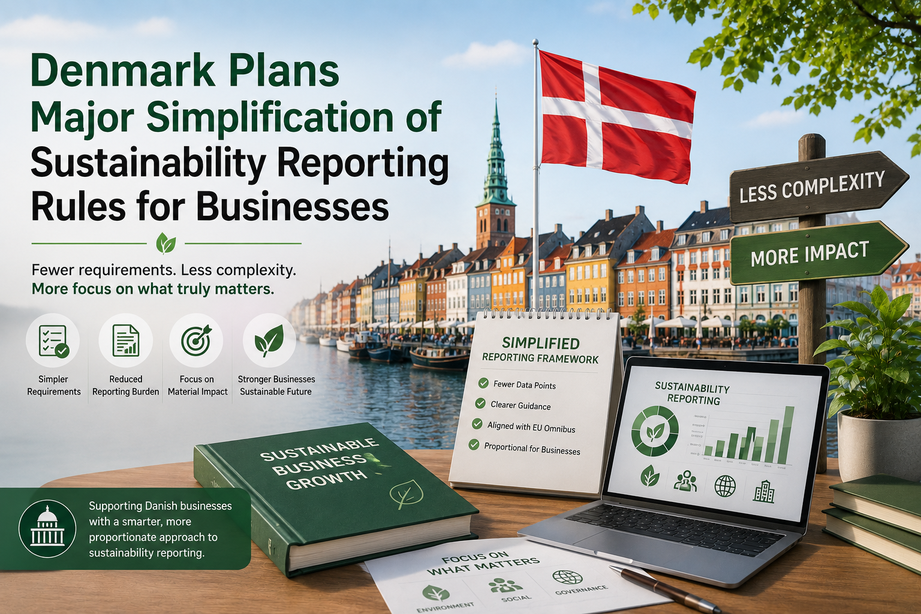
Denmark is moving ahead with a major simplification of corporate sustainability reporting rules that could remove a significant number of businesses from mandatory reporting requirements.
The changes follow the European Union’s first Omnibus simplification package, which substantially narrows the scope of the Corporate Sustainability Reporting Directive, commonly known as the CSRD.
Under Denmark’s proposed implementation, mandatory sustainability reporting would generally apply only to businesses that exceed both 1,000 employees and DKK 3.53 billion in net annual turnover.
For many Danish and international businesses, this represents a major change. Companies that previously expected to prepare extensive sustainability reports may find themselves outside the mandatory CSRD framework.
For businesses following Danish corporate and regulatory developments through Lead Roedl, the changes are particularly relevant because they affect not only sustainability teams, but also corporate reporting, management responsibilities, supply chains and relationships with international business partners.
Denmark Is Implementing the EU’s New CSRD Scope
On 2 July 2026, the Danish Business Authority sent a new legislative proposal for consultation to implement the recently adopted changes to the CSRD.
The purpose of the EU reforms is straightforward: reduce administrative burdens and make sustainability reporting requirements more proportionate.
Under the revised rules, mandatory CSRD reporting will generally apply to companies that have, for two consecutive financial years:
- More than 1,000 employees
- Net turnover exceeding DKK 3.53 billion
The Danish turnover figure corresponds to the EU threshold of €450 million.
Both conditions matter.
A business with more than 1,000 employees but turnover below the threshold would generally fall outside the revised scope. The same would apply to a company with very high turnover but 1,000 or fewer employees.
This represents a considerable narrowing of the original CSRD framework.
Many Companies Could Leave Mandatory CSRD Reporting
The biggest practical effect is likely to be the reduction in the number of businesses required to prepare statutory sustainability reports.
The original CSRD framework was designed to bring a much broader group of large businesses into sustainability reporting.
That direction has now changed.
The EU concluded that reporting obligations had become too burdensome for many businesses, particularly when compared with the benefits expected from mandatory reporting.
The new approach focuses the full reporting requirements on the largest companies.
Denmark has moved quickly in response. In February 2026, the Danish Minister for Industry, Business and Financial Affairs introduced an exemption allowing certain businesses that will ultimately fall outside the revised CSRD scope to stop mandatory sustainability reporting already for the 2025 and 2026 financial years.
For affected companies, this can mean substantial savings in time, administration and external advisory costs.
The Change Does Not Mean Sustainability Reporting Is Disappearing
Businesses should be careful not to interpret the reform as the end of sustainability reporting.
Instead, the regulatory focus is shifting.
The largest businesses will continue to face mandatory reporting obligations, while smaller businesses may increasingly provide sustainability information voluntarily or because customers, investors, lenders and larger companies request it.
A manufacturer with 400 employees, for example, may no longer be directly required to report under the CSRD.
But if that manufacturer supplies products to a major international group that remains within the CSRD, sustainability information could still be commercially important.
The difference is that there will be limits on how much information larger reporting companies can demand from smaller businesses in their value chains.
Smaller Companies Receive Greater Value Chain Protection
One of the important features of the revised EU rules concerns companies in the supply chains of larger reporting businesses.
Under the previous environment, smaller companies could face extensive sustainability information requests from customers attempting to meet their own CSRD obligations.
This created an indirect reporting burden.
A small supplier might technically fall outside the CSRD while still being asked to provide detailed emissions, workforce, environmental and governance information.
The revised framework introduces protection for businesses with 1,000 employees or fewer.
These protected companies have the right, in certain circumstances, to decline sustainability information requests that exceed what is specified in the EU’s voluntary sustainability reporting standards.
This could be particularly valuable for Danish SMEs supplying larger European businesses.
Voluntary Reporting Will Remain Relevant
Businesses outside the mandatory CSRD scope can still choose to report sustainability information.
The EU framework therefore includes standards designed specifically for voluntary reporting.
This gives smaller companies a more proportionate way to communicate environmental, social and governance information without taking on the complete reporting burden imposed on companies within mandatory CSRD scope.
Voluntary reporting could remain useful where businesses want to:
- Respond efficiently to customer sustainability requests
- Participate in large corporate supply chains
- Provide information to banks and investors
- Support tenders and procurement processes
- Communicate sustainability performance
- Prepare for future business growth
- Meet expectations from international partners
For some companies, sustainability reporting may therefore move from being primarily a legal obligation to becoming a strategic commercial choice.
Sustainability Reporting Standards Are Also Becoming Simpler
The scope of CSRD is not the only area being simplified.
The European Sustainability Reporting Standards, known as ESRS, have also undergone substantial revision.
In July 2026, the European Commission adopted simplified standards for mandatory sustainability reporting.
According to the Danish Business Authority, the simplified ESRS reduces the number of reporting data points by approximately 70%.
This is a substantial reduction.
Businesses remaining within the mandatory CSRD framework should therefore face a less complex reporting process than under the original standards.
The revised approach also gives companies greater ability to rely on reasonable and supportable information available at the time of reporting without incurring unnecessary cost.
The simplified standards can already be used for the 2026 financial year and are expected to become the required framework from the 2027 financial year.
Denmark May Also Remove a National Reporting Requirement
The Danish proposal goes beyond implementing the narrower CSRD scope.
The Danish Business Authority has also proposed removing the requirement for a separate statement on corporate social responsibility from the 2026 financial year.
This would further simplify reporting for businesses that previously had obligations under Denmark’s national corporate reporting framework.
For management teams, finance departments and sustainability professionals, these changes could reduce overlap between different reporting requirements.
The broader policy direction is clear: companies should not be required to prepare extensive sustainability information simply because several overlapping legal frameworks demand similar disclosures.
International Companies Should Review Their Danish Position
The changes are also relevant for international corporate groups operating in Denmark.
Businesses should not assume that the revised rules affect only Danish-owned companies.
The EU framework includes specific provisions concerning groups and certain non-EU companies with substantial European operations.
For companies headquartered outside the EU, the revised framework significantly raises the thresholds for when sustainability reporting obligations can arise.
Under the amended rules, relevant third-country reporting requirements focus on substantially larger operations, including a €450 million EU turnover threshold for the third-country parent and a €200 million threshold relating to qualifying EU subsidiaries or branches.
International groups should therefore review their structure rather than relying on assessments made under the original CSRD framework.
What Should Danish Businesses Do Now?
For companies that have already invested in CSRD preparation, the narrowing of the rules creates an obvious question: should they continue?
There is no single answer.
Businesses should first establish whether they remain legally within the revised scope.
They can then consider the commercial value of continuing some form of sustainability reporting.
A practical review could include:
- Checking employee numbers and net turnover against the new thresholds
- Determining whether the company qualifies for transitional relief
- Reviewing reporting obligations at group level
- Checking whether an international parent company remains subject to CSRD
- Identifying sustainability information requested by major customers
- Reviewing existing data collection processes
- Considering whether voluntary reporting remains commercially useful
- Preparing for the simplified ESRS if mandatory reporting continues
Companies that have spent several years developing sustainability data systems may decide that abandoning those processes entirely would make little commercial sense.
Others may find that a simplified voluntary approach is sufficient.
Reduced Regulation Does Not Remove Business Pressure
The legal burden may be decreasing, but market expectations surrounding sustainability are unlikely to disappear.
Banks can consider environmental risks when assessing financing. Investors may request sustainability information. Large customers can evaluate suppliers according to environmental and social criteria. Public and private procurement processes can also include sustainability requirements.
This creates an important distinction between mandatory reporting and commercially useful reporting.
A company may no longer have a legal obligation to publish a full CSRD sustainability report while still benefiting from maintaining reliable sustainability information.
For businesses, the challenge will be finding the appropriate level of reporting rather than automatically following the most extensive possible framework.
A Significant Shift in Europe’s Sustainability Strategy
The CSRD simplification represents a notable change in European regulatory policy.
The EU is not abandoning sustainability reporting. Instead, it is concentrating mandatory requirements on much larger businesses while attempting to protect smaller companies from disproportionate administrative costs.
Denmark’s proposed implementation follows that direction closely.
For companies monitoring Danish corporate developments through Lead Roedl, the changes demonstrate why businesses should continually reassess their regulatory position. A company that expected extensive CSRD obligations only a year ago may now face a very different reporting landscape.
The immediate task for businesses is therefore to determine where they fall under the revised thresholds.
For some companies, mandatory sustainability reporting will continue, but under significantly simplified standards.
For many others, the question is changing from “What must we report?” to “What sustainability information is still valuable for our customers, investors and business partners?”