
 alhodhodnews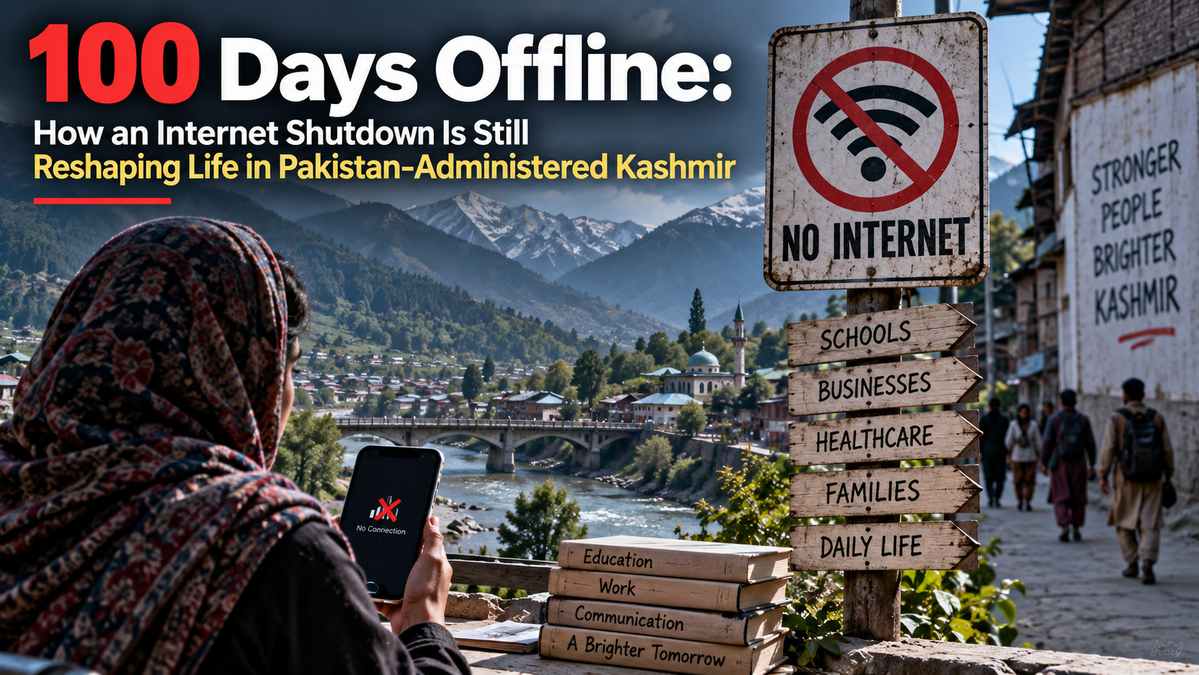
An internet shutdown that began during a period of intense political unrest in Pakistan-administered Kashmir has now crossed the 100-day mark, turning what was initially presented as a security measure into a much broader disruption of everyday life.
Mobile data and broadband services have remained restricted across parts of the territory since early June, when protests erupted over electoral and governance issues. Although elections have since been held and a new government has been formed, connectivity has not fully returned.
That creates a question bigger than internet access itself:
What happens when an emergency communication restriction continues after the political event that triggered it has already passed?
For residents, the answer is increasingly visible in classrooms, businesses, banking, news consumption and ordinary communication.
A Shutdown That Outlasted the Crisis
The restrictions began on June 5, according to NetBlocks, an independent organisation that monitors internet disruptions.
The move came as authorities confronted a protest movement demanding political and electoral changes. The unrest later intensified, producing clashes and significant casualties and eventually affecting the territory’s planned legislative elections.
More than three months later, however, the political calendar has moved forward.
The territory held its legislative elections in three phases, with the final round taking place on August 10.
A new government has subsequently been formed.
Yet internet restrictions remain.
That gap between the original emergency and the continuing restriction is what has turned the shutdown into a story of its own.
Why 100 Days Matters
An internet blackout lasting several hours can be inconvenient.
A restriction lasting several days can interfere with work and communication.
But 100 days changes the scale completely.
For students, it can mean an academic term disrupted.
For businesses, it can mean months of unreliable access to customers and digital services.
For families, it can mean difficulty maintaining routine communication.
And for citizens, it can make it harder to follow political developments or independently access information.
Al Jazeera reported that access to websites and applications used for online banking has been affected, while academic disruptions have led authorities to postpone entrance examinations.
The internet is no longer simply an entertainment service.
For many people, it is part of the basic infrastructure of modern life.
Elections Took Place Under an Information Cloud
The timing makes the shutdown particularly significant.
The region’s legislative elections were conducted after weeks of unrest, security concerns and calls for a boycott by the Jammu Kashmir Awami Joint Action Committee, or JAAC.
Because voting was divided into three phases, the election process stretched across a period in which communications restrictions remained an issue.
Al Jazeera previously reported that the election schedule was altered because of security concerns and that voting eventually took place in stages.
An election does not depend solely on people physically reaching polling stations.
Voters also need information about candidates, schedules, changes to polling arrangements and political developments.
When digital communication is restricted, that information environment changes.
The consequences depend on what alternative channels are available, but the loss of normal connectivity can make the political process more difficult to follow.
The Internet Shutdown Did Not Stop the Political Process
This is one of the striking features of the story.
Despite the disruption, the political process continued.
Voting eventually took place.
A legislature was formed.
A new government emerged.
But the restoration of political institutions did not automatically produce the restoration of full connectivity.
That makes the shutdown harder to explain simply as a temporary response to an election-related security emergency.
The situation has instead evolved into a separate policy question: how long should extraordinary communications restrictions remain in place?
Businesses Are Paying a Different Price
For a shopkeeper or small business owner, the internet can be as important as a physical storefront.
Customers increasingly use messaging applications to place orders.
Businesses rely on digital payments.
Suppliers communicate online.
Banking services operate through websites and mobile applications.
Advertising increasingly takes place through social platforms.
When connectivity disappears, those systems do not simply become slower.
They can become inaccessible.
Al Jazeera reported that online banking platforms and other everyday digital services have been affected by the restrictions.
For businesses already dealing with economic uncertainty, a prolonged communications disruption can therefore become another obstacle to recovery.
Students Have Lost More Than Convenience
Education has also been affected.
The prolonged restrictions have disrupted the academic calendar, with authorities postponing entrance examinations, according to Al Jazeera.
That matters because modern education increasingly depends on digital access.
Students use the internet to download study material, attend online classes, communicate with teachers, submit applications and prepare for examinations.
Even when schools and colleges remain physically open, students can still lose access to important parts of their education.
A 100-day restriction can therefore create effects that continue long after internet service is eventually restored.
The Information Gap Is Another Problem
During a period of political tension, access to reliable information becomes particularly important.
Residents need to know what is happening around them.
Journalists need to communicate with sources.
Families need to share information.
Businesses need to understand changing conditions.
Authorities also need ways to communicate official announcements.
A communications shutdown affects all of these functions at once.
That does not automatically mean every restriction is unjustified. Governments can impose temporary communication limits in response to serious security threats.
The difficult question is proportionality and duration.
A measure designed for an emergency becomes a different kind of policy when it remains in place for months.
Restrictions Have Not Been Uniform
It is important not to describe the situation as though every person in the territory has experienced exactly the same level of disruption throughout the entire 100-day period.
Internet services have been restored in some areas at different times, while restrictions have continued elsewhere.
Dawn reported in July that internet services returned to parts of Muzaffarabad after 54 days, although users still complained about slow cellular data.
More recent reporting has similarly described the shutdown as partial rather than an absolute absence of every form of connectivity everywhere.
That distinction matters because the practical experience can vary considerably from one district to another.
The Government Has Promised Restoration
Authorities have announced phased restoration measures.
According to recent reporting, the regional government ordered services restored in some districts and partially restored in others from August 31. However, connectivity has remained incomplete in parts of the territory.
The region’s High Court has also become involved.
Outlook reported that the court directed the government to restore internet services within 10 days, while allowing an exception for areas where law-and-order conditions were considered unsuitable.
That development changes the nature of the debate.
The question is no longer simply whether authorities recognize the economic and social cost of the shutdown.
It is increasingly about when and under what conditions normal connectivity should return.
Why the Original Protests Matter
The internet shutdown cannot be separated from the political unrest that preceded it.
The protests were connected to demands involving electoral representation and governance in Pakistan-administered Kashmir.
The movement also objected to the allocation of reserved legislative seats for refugees living elsewhere in Pakistan, among other grievances.
The authorities banned the protest movement, while clashes between demonstrators and security forces later became deadly.
The government has presented security and public-order concerns as important factors behind its response.
Critics and rights organizations, however, have raised concerns about the broader restrictions imposed during the crackdown. Amnesty International has described the internet shutdown as part of a wider pattern of restrictions and alleged abuses. Those are the organization’s assessments, not independently established findings on every allegation.
A Shutdown Creates Its Own Information Problem
There is an irony at the heart of prolonged internet restrictions.
Authorities may impose them partly to control the spread of unrest or misinformation.
But the same restrictions can make it harder for residents to obtain verified information.
When official and independent digital channels become difficult to access, people may rely more heavily on word of mouth, private networks or whatever communication channels remain available.
That can make information harder—not easier—to verify.
In a modern society, controlling communication does not necessarily eliminate uncertainty.
Sometimes it simply changes where people look for answers.
The Economic Cost Can Outlive the Political Crisis
The political crisis that triggered the restrictions may eventually subside.
Economic damage can last longer.
A student who misses an examination cannot necessarily recover the lost opportunity immediately.
A business that loses customers during months of unreliable connectivity may not automatically regain them.
A worker who depends on digital communication may lose income.
These effects accumulate quietly.
They rarely produce dramatic headlines.
But after 100 days, they can become a significant part of the region’s economic story.
What Happens Next?
The central issue is whether the authorities can move from emergency restrictions toward normal connectivity without reopening the security problems that prompted the original shutdown.
The High Court’s intervention, government restoration announcements and the formation of a new administration all point toward pressure for a more lasting resolution.
But restoring internet access completely is only one part of the challenge.
The deeper political grievances that produced the protests remain important.
So does the question of how authorities respond to future demonstrations.
If another crisis emerges, residents and businesses will want to know whether communications restrictions will again become one of the first tools used by authorities—and whether there will be clear limits on their duration.
The Bigger Meaning of 100 Days Offline
The story of Pakistan-administered Kashmir’s internet shutdown is ultimately about more than smartphones and broadband connections.
It is about how deeply digital communication has become woven into modern society.
An internet connection now links a student to an examination, a shopkeeper to a customer, a worker to an employer, a family to relatives and a voter to political information.
Disconnecting that network for a prolonged period therefore creates consequences far beyond the screen.
The most striking fact is not simply that the shutdown reached 100 days.
It is that the political circumstances that triggered it have changed, elections have taken place and a new government is in office—yet the communication restrictions have not fully disappeared.
That leaves Pakistan-administered Kashmir facing a question that cannot be answered by technology alone:
When does a temporary security measure stop being temporary?
The answer will determine not only when residents can return fully to the digital economy, but also how the region balances security, political participation, education, commerce and access to information after one of its most disruptive periods in years.