 alhodhodnews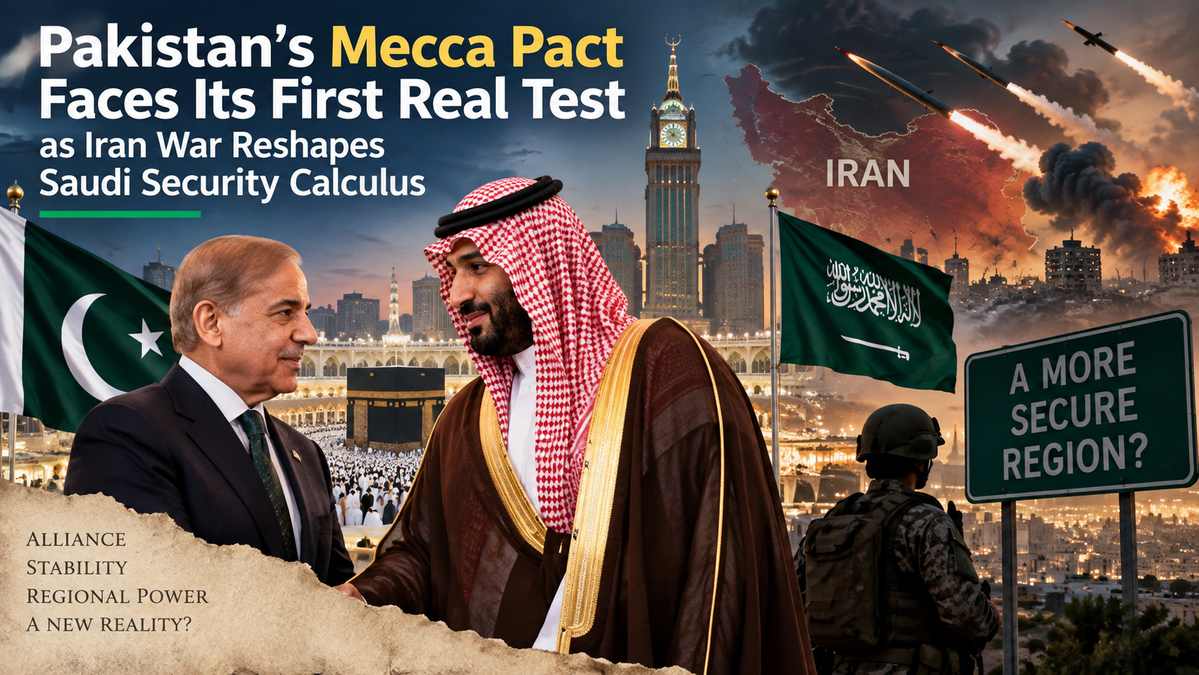
Pakistan’s diplomatic profile in the Middle East has risen sharply during the Iran war. Islamabad has close ties with Saudi Arabia, maintains a working relationship with Iran, and is now part of a new defence arrangement linking Saudi Arabia, Türkiye and Pakistan.
But the regional crisis is raising a more practical question than whether Pakistan has suddenly become an important diplomatic player:
What can the new alliance actually do when Saudi Arabia faces a real security threat?
That question has become harder to avoid as attacks linked to Yemen’s Houthi movement have targeted Saudi interests and exposed vulnerabilities around the Red Sea and Bab el-Mandeb. At the same time, Pakistan has been trying to communicate with Tehran and avoid being pulled directly into the conflict.
The result is a delicate balancing act in which Pakistan’s diplomatic importance and its military commitments do not necessarily point in the same direction.
The Mecca Pact Has Moved From Ceremony to Reality
Saudi Arabia, Türkiye and Pakistan signed the Mecca Joint Defence Agreement in August 2026. The agreement established a framework for coordinated security cooperation, including the principle that an armed attack against one member would be treated as an attack against all three.
The pact immediately attracted comparisons with NATO’s collective-defence principle.
But comparisons can obscure an important point.
A defence agreement is not automatically the same thing as an automatic decision to launch military operations.
Its real meaning depends on how the participating governments interpret an attack, what kind of response they consider necessary and how far they are prepared to go.
That is precisely why the current Saudi-Houthi confrontation matters.
Pakistan Is Suddenly Standing Between Two Difficult Relationships
Islamabad has a complicated strategic position.
On one side is Saudi Arabia, a longstanding economic and security partner. On the other is Iran, Pakistan’s neighbor, with which Islamabad maintains diplomatic and economic ties and shares a border.
The Houthi conflict puts those relationships on a collision course.
Reuters reported that Pakistan delivered messages to Iran urging Tehran to restrain the Houthis while also engaging with Iranian officials. Islamabad is therefore attempting to act as a channel for de-escalation while remaining committed to its relationship with Riyadh.
That is very different from openly joining military operations against the Houthis.
And that distinction may ultimately define Pakistan’s role.
The First Test Has Not Produced a Pakistani Military Intervention
The clearest indication of Islamabad’s current position came from Pakistan itself.
On September 10, Pakistan’s Foreign Office said there had been no discussion of a military response by Islamabad under the Mecca pact in relation to Houthi attacks on Saudi Arabia. Officials said Pakistan would act according to the agreement’s requirements while condemning attacks on Saudi territory.
This does not mean the agreement has failed or that Pakistan has rejected its commitments.
It does show, however, that collective defence does not necessarily translate into immediate combat involvement.
That distinction is crucial for understanding the pact.
The agreement may provide deterrence, political reassurance and mechanisms for coordination without requiring every member to participate in every military operation.
Why the Houthi Threat Is Different From a Conventional War
The Saudi challenge is also complicated by the nature of the attacks.
The Houthis have demonstrated an ability to use missiles and drones and to threaten maritime routes connected to the Red Sea.
The Bab el-Mandeb Strait is particularly important because it links the Red Sea with the Gulf of Aden and provides a major route for international shipping.
The wider conflict has already created pressure on energy markets and shipping routes, while Saudi Arabia has faced attacks on important energy infrastructure.
For Riyadh, therefore, the security problem is not confined to one battlefield.
It involves air defence, energy infrastructure, maritime security and the protection of major economic routes.
That makes the question of what each member of the Mecca pact can contribute much more complicated than simply counting soldiers.
Pakistan May Be More Valuable as a Diplomatic Channel
One of Islamabad’s unusual advantages is that it can communicate with both sides of the regional divide.
Pakistan has longstanding ties with Saudi Arabia, but it also shares a border with Iran and has maintained diplomatic channels with Tehran.
During the current escalation, that position has encouraged Islamabad to pursue a mediator role.
Reuters reported that Pakistan warned Iran to rein in its Houthi allies after attacks on Saudi interests.
From Riyadh’s perspective, that diplomatic channel could be useful even if Pakistani troops are not entering Yemen.
In other words, Pakistan’s contribution to Saudi security may not always be measured in military deployments.
It can also be measured in access, communication and crisis diplomacy.
But Mediation Has Limits
There is an obvious problem with this role.
A mediator needs credibility with both sides.
Pakistan’s defence relationship with Saudi Arabia makes Islamabad an interested party rather than a completely neutral outsider.
Reuters noted that the crisis is testing Pakistan’s ability to balance its role as a Saudi defence partner with its relationship with Tehran.
That means Islamabad faces a narrow path.
Move too close to Riyadh militarily, and its ability to communicate with Iran could weaken.
Move too far toward Tehran, and questions could arise about the strength of its commitment to Saudi Arabia.
The diplomatic value of Pakistan may therefore depend partly on its ability to maintain both relationships simultaneously.
Saudi Arabia Is Not Relying on One Security Partner
Another development complicates the idea that the Mecca pact alone will determine Saudi Arabia’s response to the current crisis.
Reuters reported on September 16 that Saudi Arabia sought intelligence assistance from Israel through US Central Command as Houthi attacks intensified. The reported cooperation is focused on security and intelligence rather than representing a formal Saudi-Israeli alliance.
That development illustrates how governments behave during fast-moving security crises.
They can build new alliances while continuing to use older partnerships.
They can seek assistance from countries with which they have no formal diplomatic relationship.
And they can ask different partners to perform different functions.
The emerging regional security system is therefore more complicated than a single three-country bloc.
Türkiye Adds Another Layer
Türkiye is the third member of the Mecca arrangement, giving the pact a geographic reach stretching from South Asia into the Middle East and onward toward the Mediterranean.
The three countries have discussed mechanisms involving senior officials, military exercises and defence-industry cooperation.
But Türkiye also has its own regional interests and security calculations.
That means the alliance’s future will depend on whether the three governments can turn political commitments into practical coordination.
Joint exercises are relatively straightforward.
Agreeing on what constitutes an attack, deciding how to respond and determining who contributes what are considerably harder.
Pakistan’s Military Strength Is Only One Part of the Equation
Much of the attention surrounding Pakistan’s role comes from the country’s large military and nuclear capability.
But military strength does not automatically determine diplomatic influence.
A country can possess substantial military capabilities while still choosing not to deploy them in a particular conflict.
Pakistan has previously indicated that its defence arrangements with Saudi Arabia should not automatically be interpreted as extending its nuclear deterrent to the kingdom. Reuters reported in 2025 that Islamabad had said nuclear weapons were not part of the immediate discussion around its Saudi defence relationship.
That distinction remains important because speculation about a broader “nuclear umbrella” can obscure what the agreements actually say.
The public commitments should be separated from assumptions about capabilities that have not been formally promised.
The Economic Dimension Matters Too
Pakistan’s growing relationship with Saudi Arabia is not purely military.
Islamabad is seeking investment, economic support and stronger Gulf partnerships at a time when its economy faces considerable pressures.
Riyadh, meanwhile, has its own interest in building additional security relationships rather than depending exclusively on one external power.
That gives the partnership a transactional dimension.
Security cooperation can reinforce economic ties, while economic ties can make governments more willing to deepen security cooperation.
But it can also create competing priorities.
Pakistan has to consider the cost of becoming directly involved in conflicts that could affect its own economy and regional security.
The Real Test Is Still Ahead
The current crisis has exposed the difference between having a defence agreement and having a fully developed collective-security system.
The Mecca pact provides a framework.
What remains uncertain is how that framework will operate under sustained pressure.
Would an attack on Saudi territory produce a joint military response?
Would the response depend on who carried out the attack?
Would members contribute troops, intelligence, air defence, logistics or diplomatic support?
And how would the three governments respond if protecting one member’s interests created risks for another?
These questions are not necessarily signs that the agreement is ineffective.
They are the normal questions that arise when a new security arrangement moves from political declaration to practical implementation.
Pakistan’s New Role Is Bigger—But Also More Complicated
The Iran war has undoubtedly given Pakistan more diplomatic visibility.
Islamabad is now positioned between Saudi Arabia and Iran at a moment when their security interests are increasingly intertwined with the wider conflict.
But visibility should not be confused with unlimited influence.
Pakistan can talk to Tehran.
It can reassure Riyadh.
It can participate in a new trilateral defence structure.
It can also contribute military capabilities if the agreement’s members decide that circumstances require them.
Yet each of those roles has limits.
The most important development may therefore be that Pakistan is being asked to perform several jobs at once: security partner, diplomatic intermediary and regional stakeholder.
Those roles can complement one another, but they can also collide.
What the Mecca Pact Will Ultimately Have to Prove
The next stage of the pact will not be determined by headlines comparing it with NATO.
It will be determined by institutions, planning and decisions made during real crises.
The agreement has already produced closer defence coordination among Saudi Arabia, Türkiye and Pakistan, while the current conflict is forcing the three countries to confront difficult questions about their respective responsibilities.
For Pakistan, the challenge is particularly delicate.
Its value to Saudi Arabia may come not only from military capacity but also from its ability to maintain a channel to Iran.
For Saudi Arabia, the pact adds another layer to an already complicated network of security partnerships.
And for Türkiye, it offers a mechanism for deeper regional defence cooperation.
The Iran war has therefore done something important: it has turned the Mecca pact from a new diplomatic announcement into an arrangement that must now demonstrate how its promises work in practice.
Pakistan’s newfound regional role is real in the sense that more governments are seeking its participation and mediation. How durable and consequential that role becomes will depend less on the publicity surrounding the pact and more on what Islamabad, Riyadh and Ankara actually do when their interests converge—and when they do not.