 alhodhodnews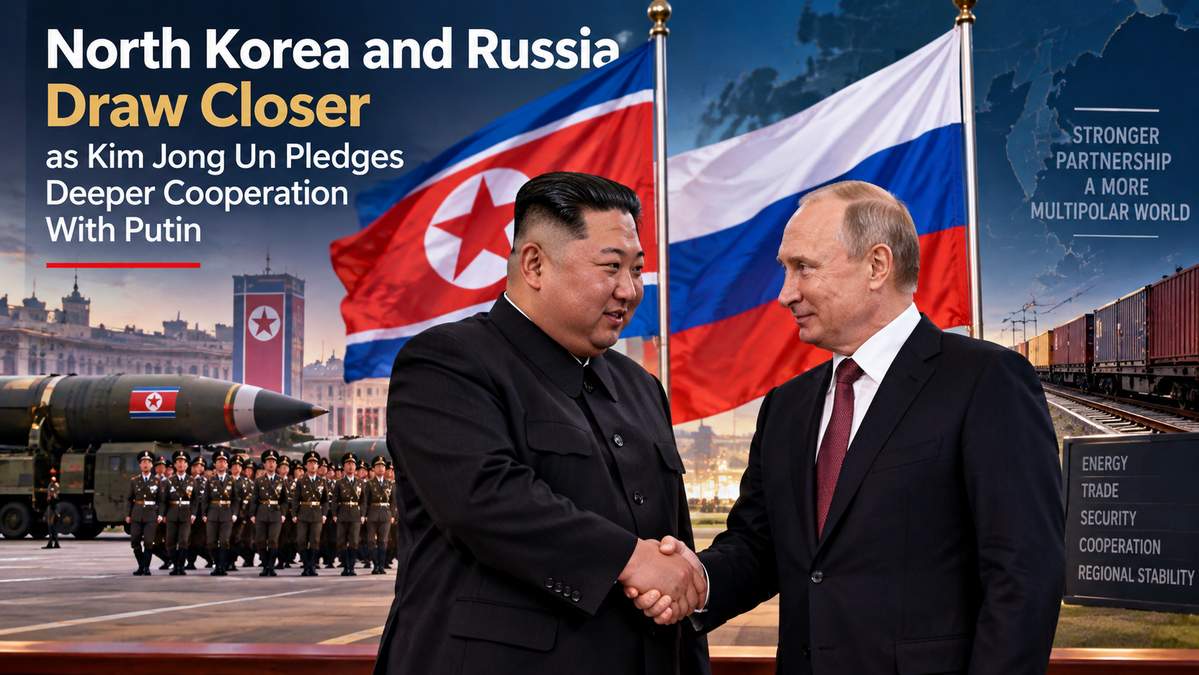
North Korea’s relationship with Russia is moving beyond diplomatic friendship and into a more consequential strategic partnership.
North Korean leader Kim Jong Un has pledged to expand and deepen cooperation with Russian President Vladimir Putin, while expressing what he called unwavering support for Moscow and confidence in Russia’s victory in its war against Ukraine.
The remarks were delivered in a message to Putin marking North Korea’s 78th founding anniversary. Kim described the relationship between Pyongyang and Moscow in terms of friendship, mutual assistance and alliance, according to North Korean state media KCNA.
But the language matters for a reason beyond symbolism.
North Korea and Russia have spent the past several years turning a historically important relationship into a much closer military and strategic partnership. The latest message suggests Pyongyang intends to keep that relationship moving in the same direction.
Kim’s Message Was More Than a Diplomatic Greeting
Putin had sent Kim congratulations for North Korea’s anniversary on September 9.
Kim’s response, sent on September 14, went considerably further than a routine exchange of diplomatic courtesies.
He said North Korea would broaden cooperation with Russia “in a comprehensive way” and emphasized what he described as the two countries’ alliance relationship. He also pledged continued support for Putin and the Russian people.
That language reflects how dramatically the relationship has changed.
For years, Moscow and Pyongyang maintained diplomatic ties without operating as particularly close strategic partners.
The war in Ukraine altered that calculation.
North Korea’s Role in the Ukraine War Changed the Relationship
The most significant development in recent years has been North Korea’s direct military support for Russia.
Reuters reported that North Korea sent troops to fight alongside Russian forces in Ukraine in 2024. The two governments have also deepened military cooperation under a mutual-defense pact.
That has given the relationship a practical dimension that goes well beyond traditional diplomatic statements.
Instead of simply exchanging political support, the two governments have developed mechanisms for military cooperation.
For Moscow, the partnership provides another source of support during a prolonged war.
For Pyongyang, closer ties with Russia offer access to a major military power and create another important diplomatic relationship at a time when North Korea remains heavily sanctioned internationally.
The exact details of military assistance and what each side receives in return remain difficult to assess because both governments tightly control information.
What Does Kim Mean by a “Sacred War”?
Kim said he was convinced Russia would win what he described as a “sacred war” to defend the country’s security interests and international justice.
His wording appeared to refer to Russia’s war in Ukraine.
That is Kim’s characterization, not a neutral description of the conflict.
The language is nevertheless significant because it demonstrates the extent to which Pyongyang has aligned itself rhetorically with Moscow’s presentation of the war.
Rather than simply saying North Korea supports Russia, Kim framed Russia’s campaign as a legitimate struggle connected to national security and international justice.
That places North Korea firmly on Moscow’s side of the conflict.
The Partnership Is Becoming Institutional
One of the biggest changes in the relationship is that cooperation is no longer based solely on personal ties between Kim and Putin.
The two countries have established a broader framework for cooperation, including their mutual-defense agreement.
That matters because institutions and formal agreements can outlast individual meetings.
The relationship is therefore becoming less dependent on occasional summit diplomacy and more embedded in the strategic calculations of both governments.
The result is a partnership that could remain important even if circumstances surrounding the Ukraine war change.
Russia Offers North Korea Another Major International Partner
North Korea has long faced diplomatic isolation and extensive international sanctions.
Closer relations with Russia give Pyongyang another powerful state with which it can conduct diplomacy, trade and strategic cooperation.
Russia also occupies a permanent seat on the UN Security Council, making its relationship with Moscow particularly significant for Pyongyang.
That does not mean Russia can simply remove the international sanctions imposed on North Korea.
But the relationship gives North Korea an additional diplomatic channel and reduces its dependence on any single external partner.
That is particularly important because North Korea is simultaneously trying to maintain its longstanding relationship with China.
Kim Also Sent a Message to Xi Jinping
Kim’s diplomatic outreach was not limited to Moscow.
He also sent a message to Chinese President Xi Jinping, promising to develop the traditional friendship between North Korea and China and advance what KCNA described as their shared socialist cause.
The timing is notable.
North Korea is strengthening its relationship with Russia while continuing to emphasize its longstanding ties with China.
Rather than choosing between the two, Pyongyang appears to be maintaining relationships with both major powers.
That gives Kim greater diplomatic room to maneuver.
Why China Still Matters
China remains North Korea’s most important traditional economic and diplomatic partner.
The Kim-Xi relationship therefore remains central to Pyongyang’s foreign policy.
At the same time, the rise of Russia as a closer strategic partner gives North Korea another avenue for cooperation.
The three-country relationship should not automatically be interpreted as a formal alliance involving all three governments.
China and Russia have their own interests, while North Korea pursues its own priorities.
But from Pyongyang’s perspective, maintaining strong ties with both countries can create more strategic options.
The Ukraine War Has Created a New Diplomatic Geography
One of the broader consequences of the Ukraine conflict has been the emergence of relationships that might have seemed unlikely or less important before the war.
Russia has strengthened ties with countries willing to maintain cooperation despite Western sanctions and diplomatic pressure.
North Korea is one of the clearest examples.
The relationship demonstrates how a conflict in Europe can produce consequences far beyond the European continent.
Military cooperation between Moscow and Pyongyang connects security calculations in Northeast Asia with developments on the European battlefield.
That creates a much wider geopolitical picture.
What Moscow Gets From Pyongyang
The strategic benefits for Russia are an important part of the story.
North Korea has significant military resources and a large defense-industrial base, while its government has demonstrated a willingness to openly support Moscow’s war effort.
North Korean troops have already been involved alongside Russian forces, according to Reuters.
For Russia, maintaining this relationship can therefore provide practical military and political value.
It also demonstrates that Moscow has partners outside the Western-led diplomatic system.
What Pyongyang Gets in Return
For North Korea, the potential benefits are different.
Closer ties with Russia can provide economic cooperation, diplomatic backing and military links.
The relationship may also give Pyongyang access to Russian expertise and technology, although the precise nature and extent of such cooperation are not always publicly disclosed.
This uncertainty makes it difficult to determine the full value of the partnership.
What is clear is that both governments see enough benefit in the relationship to repeatedly describe it in increasingly strategic terms.
The Partnership Could Affect Northeast Asia Too
The consequences are not limited to Ukraine.
South Korea, Japan and the United States have closely monitored the growing cooperation between Moscow and Pyongyang.
Any transfer of military knowledge, technology or resources between Russia and North Korea could have implications for the security environment surrounding the Korean Peninsula.
At the same time, North Korea’s participation in the Ukraine war has demonstrated that Pyongyang is willing to project its military relationship beyond Northeast Asia.
That represents a significant development in how North Korea’s foreign and security policy is viewed.
Kim’s Language Signals Continuity, Not a Temporary Alignment
The most important part of Kim’s latest message may be his promise to expand and deepen cooperation.
That wording suggests continuity.
North Korea is not presenting its relationship with Russia as a temporary arrangement created by the Ukraine conflict.
Instead, Kim is describing it as a long-term partnership based on friendship, mutual assistance and alliance.
Whether that vision develops into deeper economic, military and technological cooperation will depend on decisions made by both governments.
But the political message is already clear.
Pyongyang wants Moscow to remain an important part of its foreign-policy strategy.
A Partnership Built Around Mutual Interests
The Russia-North Korea relationship is sometimes reduced to a simple exchange: Moscow needs military support, while Pyongyang wants assistance.
The reality is more complicated.
Both governments have broader strategic interests.
Russia wants to strengthen its international partnerships and maintain access to military and political support outside the Western alliance system.
North Korea wants to reduce isolation, strengthen its security position and cultivate relationships with powerful states.
Those interests overlap.
That overlap is what gives the partnership staying power.
The Bigger Shift Behind Kim’s Message
Kim’s latest message to Putin may have been prompted by a national anniversary, but its significance reaches beyond the occasion.
It confirms that the relationship between Moscow and Pyongyang has entered a different phase.
North Korea has openly backed Russia’s war in Ukraine, sent troops to fight alongside Russian forces and formalized closer military cooperation through a mutual-defense pact. Kim is now promising that cooperation will expand further.
At the same time, his parallel message to Xi shows that Pyongyang is continuing to cultivate its relationship with China.
The emerging picture is therefore not simply of North Korea moving into Russia’s orbit.
It is of Pyongyang attempting to strengthen relationships with multiple major powers at once.
For Russia, the partnership provides an important source of political and military support.
For North Korea, it creates another strategic pillar.
And for the wider international community, it shows how the consequences of the Ukraine war are continuing to reshape relationships far beyond the battlefield.
The real significance of Kim’s latest message, then, may not be his prediction of a Russian victory.
It is his promise that the Russia-North Korea partnership is not going away—and that Pyongyang intends to make it deeper, broader and more durable.