 alhodhodnews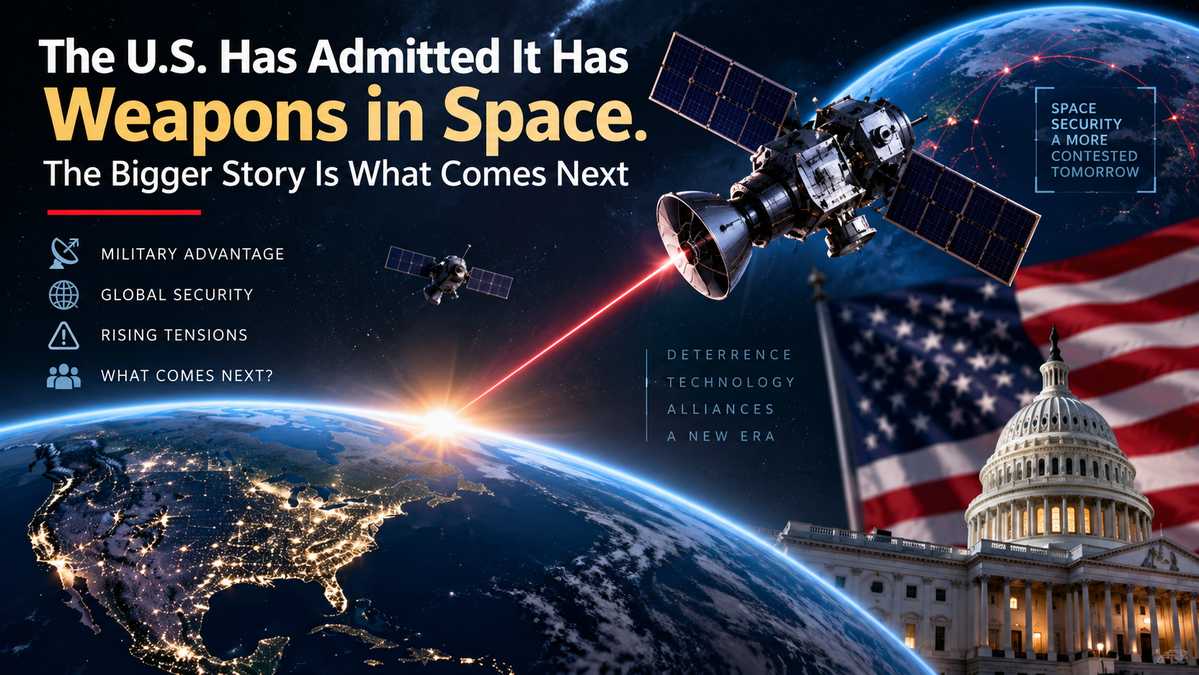
For decades, space warfare has existed in an uncomfortable gray area. Governments have developed satellites capable of tracking objects, disrupting communications and supporting military operations, while publicly avoiding detailed discussions about offensive systems in orbit.
That ambiguity has now changed.
The United States has publicly acknowledged for the first time that it has “on-orbit space control weapons” capable of defending American forces against hostile actions. Air Force Secretary Troy Meink made the disclosure at the Air and Space Forces Association’s Air, Space & Cyber Conference in Maryland.
The announcement is significant not because Washington suddenly revealed exactly what it has placed in orbit. It did not.
The more important development is that the United States has moved from years of warnings about potential space weapons to openly confirming that it possesses some of its own.
And that could change how other countries calculate their next move.
What Exactly Has the U.S. Put in Orbit?
That remains the biggest unanswered question.
Meink did not disclose the type, number, location or deployment date of the weapons. He described them only as on-orbit space-control weapons designed to defend the Joint Force against hostile adversary action.
That wording leaves considerable room for interpretation.
Experts have suggested that possible systems could include electronic jammers, systems designed to interfere with or deceive sensors, laser-based technologies or other counterspace capabilities.
But those possibilities should not be presented as confirmed descriptions of the U.S. arsenal.
Ars Technica, citing space-security experts, noted that space-control capabilities can include non-kinetic systems such as jammers and laser dazzlers. It also pointed out that there is no public indication that the newly acknowledged weapons are kinetic anti-satellite systems that physically destroy spacecraft.
So the headline is clear.
The hardware is not.
Why Make the Announcement Now?
The timing may be as important as the disclosure itself.
Meink said the United States was increasing readiness against existing threats. He also linked the decision to longstanding U.S. concerns about the development of space capabilities by China and Russia.
From Washington’s perspective, openly acknowledging the capability can serve a deterrence purpose.
The basic idea is straightforward: if an adversary knows that attacking American satellites could trigger a response, it may think twice before doing so.
This is not a new principle in military strategy.
What is changing is the environment in which it is being applied.
Space is becoming increasingly important to military operations on Earth.
Modern Militaries Cannot Fight Without Space
Satellites are involved in far more than sending television signals or providing navigation for civilian users.
Military forces depend on space-based systems for communications, positioning, intelligence, surveillance, missile warning and other functions.
That creates a strategic vulnerability.
If a country relies heavily on satellites, those satellites can become targets.
The Pentagon has spent years warning about Chinese and Russian capabilities that could threaten U.S. space assets. Washington has also accused Russia of developing an anti-satellite weapon and has highlighted Chinese advances in operating spacecraft close to other satellites.
The result is something resembling a security dilemma.
One country develops capabilities because it fears another country may attack its satellites.
The other country sees those capabilities and develops its own systems in response.
The cycle can continue even if neither side initially wants a war in space.
The Disclosure Changes the Conversation
Until now, much of the discussion surrounding American space weapons involved inference.
Officials talked about threats.
Analysts studied military launches.
Researchers tracked unusual spacecraft movements.
Governments accused one another of developing counterspace technologies.
Now Washington has removed one layer of uncertainty.
The United States is saying publicly that weapons are already in orbit.
That does not tell potential adversaries everything they want to know.
In fact, the ambiguity may be deliberate.
A capability can sometimes be more useful as a deterrent when an opponent knows it exists but does not know precisely how it works.
That appears consistent with Meink’s emphasis on deterrence while withholding operational details.
China and Russia Have Responded
The announcement immediately produced criticism from Beijing and Moscow.
China warned that the deployment could contribute to an arms race in space and urged Washington to avoid turning outer space into a military battlefield.
Russia also criticized the U.S. announcement, arguing that placing weapons in orbit could undermine long-term stability and create risks for civilian activities that depend on space infrastructure.
Those objections come from governments that themselves possess or are accused of developing military counterspace capabilities.
That does not make the concerns irrelevant, but it does mean their statements should be understood within the broader strategic competition among the major space powers.
The central problem is that every new capability can be interpreted simultaneously as defensive preparation by its owner and an offensive threat by its competitor.
Space Is Already Militarized—But Weaponization Is Different
There is an important distinction that can easily get lost in the headlines.
Space has been militarized for decades.
Military satellites have supported navigation, communications, surveillance and early-warning systems since the early space age.
The new development is the acknowledged presence of weapons designed for space control.
That distinction matters because satellites providing information are not necessarily the same thing as systems intended to interfere with or attack another country’s space assets.
The new disclosure therefore represents another step in the evolution of military activity beyond Earth’s atmosphere.
The 1967 Space Treaty Has Limits
The announcement also raises an obvious legal question.
Does international law prohibit countries from putting weapons in space?
The answer is more complicated than a simple yes or no.
The 1967 Outer Space Treaty prohibits placing nuclear weapons and other weapons of mass destruction in orbit or stationing them on celestial bodies. It also prohibits military bases and certain military activities on the Moon and other celestial bodies.
But the treaty does not impose a blanket ban on every conventional weapon in Earth orbit.
That gap has become increasingly important as technology has advanced.
When the treaty was negotiated, the concept of sophisticated maneuvering satellites, orbital jammers and other counterspace systems was largely outside the practical military environment.
Today, those possibilities are much more relevant.
The Biggest Risk May Be Miscalculation
Space warfare would not necessarily begin with a dramatic missile launch.
A conflict could start with something much harder to interpret.
A communications satellite could suddenly stop working.
A navigation signal could be disrupted.
A spacecraft could approach another satellite unusually closely.
A sensor could be blinded.
If military commanders cannot immediately determine whether an incident is accidental, technical or deliberate, the danger of escalation increases.
That is why transparency and communication can matter even when countries remain strategic competitors.
The irony is that revealing some capabilities can strengthen deterrence while revealing too much could compromise military effectiveness.
Finding that balance will become increasingly difficult.
Why Debris Makes Orbital Warfare Especially Dangerous
There is another problem that makes space different from many conventional battlefields.
Destroying a satellite can create thousands of pieces of debris.
Those fragments can remain in orbit and threaten unrelated spacecraft.
A weapon used against one country’s satellite can therefore create a hazard for satellites belonging to allies, commercial companies or even the country that launched the attack.
This is one reason analysts have distinguished between kinetic anti-satellite weapons and non-kinetic systems such as jammers or lasers.
A physical collision can leave a dangerous orbital cloud, while electronic interference may produce different—and potentially more reversible—effects. Experts cited by Ars Technica have emphasized this distinction when discussing the newly acknowledged U.S. capability.
The New Space Race Is Not Just About Rockets
The competition is also changing in another important way.
The most important space technology may not always be the rocket that launches a satellite.
It could be the spacecraft that can maneuver around another satellite.
It could be an electronic system capable of disrupting communications.
It could be software that detects unusual activity.
Or it could be a system that protects a satellite from interference.
That means the emerging competition is increasingly about control of the orbital environment, not simply reaching orbit.
The U.S. Space Force, created in 2019, was established specifically to organize and equip American forces for military operations in space.
The latest disclosure shows how far that mission has evolved.
A New Era of Strategic Ambiguity
There is a curious paradox in the announcement.
Washington is being more transparent by admitting that weapons are in orbit.
At the same time, it remains highly secretive about what those weapons actually are.
That creates a new form of strategic ambiguity.
Russia and China now know the United States has acknowledged an orbital weapons capability.
But they do not publicly know its full range, location, number or operational characteristics.
That may be exactly the point.
The disclosure sends a message without giving away the details required to neutralize the systems.
What Happens If Other Countries Follow?
This may ultimately be the most consequential question.
If China or Russia responds by publicly acknowledging additional orbital weapons, other governments could face pressure to develop or deploy their own counterspace capabilities.
More countries already possess some form of counterspace technology, according to space-security researchers. Scientific American reported that at least 13 countries have developed such capabilities of some kind, including technologies involving co-orbital spacecraft and systems for tracking objects in space.
The result could be a gradual normalization of weapons in orbit.
And once that happens, reversing the trend could become considerably harder.
The Real Battlefield May Still Be on Earth
There is another way to understand this development.
Space weapons are ultimately being developed because modern conflict on Earth increasingly depends on space.
Armies need communications.
Aircraft need navigation.
Missile systems need tracking.
Commanders need intelligence.
Civilian infrastructure also relies heavily on satellites.
That means the fight for space is partly a fight over the systems that make modern society function on Earth.
The distinction between “space security” and “national security” is therefore becoming increasingly difficult to maintain.
The Bigger Story Behind America’s Admission
The most important fact is not that the United States suddenly discovered space weapons.
Governments have been developing counterspace technologies for years.
The important change is that Washington has now publicly crossed a line of acknowledgment.
For the first time, a senior U.S. defense official has confirmed that American weapons are already deployed in orbit, while providing few details about their capabilities.
That changes the conversation from “Are space weapons coming?” to “How will countries prevent competition over them from becoming a conflict?”
The answer will depend on more than technology.
It will involve military doctrine, communication between rivals, international agreements and decisions about what kinds of actions should be considered unacceptable in orbit.
For now, the United States has revealed the existence of the weapons but kept their capabilities largely behind a curtain.
That may make the announcement more powerful as a deterrent—but it also leaves the world with an important unanswered question:
As more countries prepare to defend their interests in space, who will establish the rules for what happens when those defenses meet?