 alhodhodnews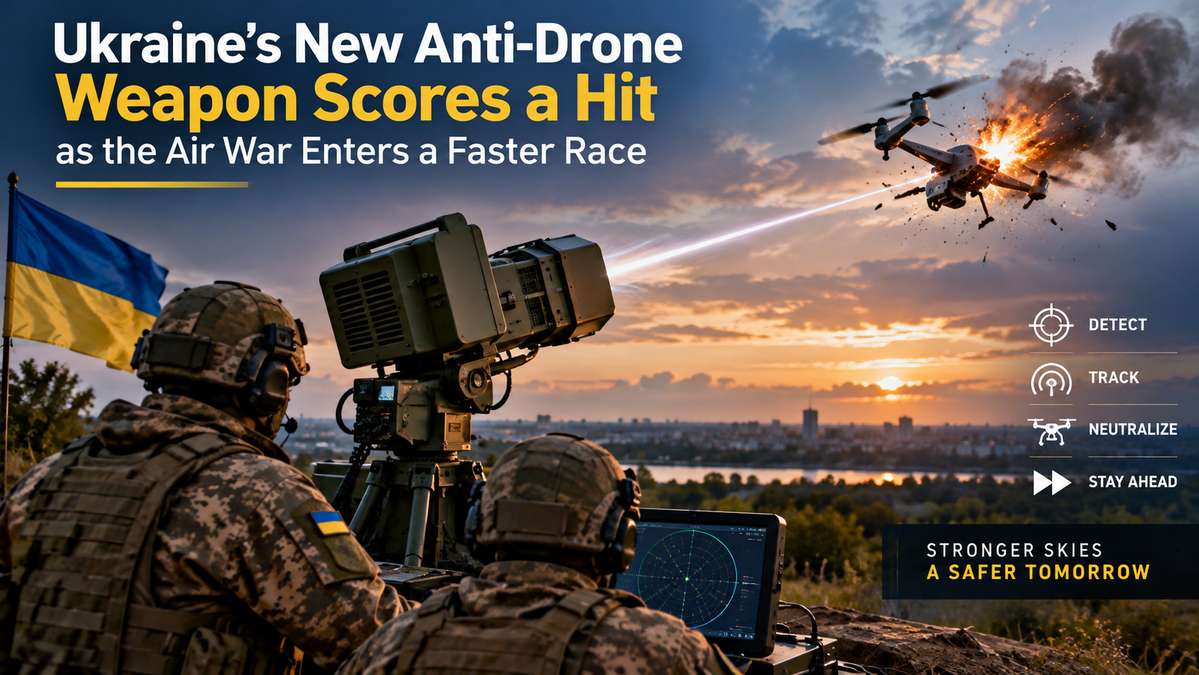
The next stage of the war in Ukraine may be decided not only by how many drones Russia can launch, but by how cheaply and quickly Ukraine can stop them.
That race has become more urgent as Russia introduces faster, jet-powered versions of the Shahed-type attack drones it has used extensively against Ukrainian cities and infrastructure.
On Tuesday, Ukrainian President Volodymyr Zelenskyy announced that a newly developed Ukrainian interceptor had successfully destroyed a Shahed drone during testing. He said the weapon still needed technical improvements, but described the result as an important step in Ukraine’s effort to build a new layer of air defense.
The significance goes beyond one successful test.
Ukraine is facing an increasingly difficult equation: faster drones, larger attack waves and the need for defenses that can be produced in large numbers without exhausting expensive missile stocks.
The Drone Threat Is Changing
The Shahed has been one of the defining weapons of Russia’s long-range campaign against Ukraine.
The original Iranian-designed system, and Russia’s domestically produced variants generally known as Geran, are relatively inexpensive compared with sophisticated cruise or ballistic missiles. Russia has been able to use them in large numbers, forcing Ukraine to spend resources detecting and destroying incoming threats.
But Moscow has not simply continued producing the same aircraft.
Russia is now deploying jet-powered variants that are substantially faster than earlier piston-engine versions. The Guardian reported that these newer Shaheds can exceed 400 km/h, creating a more demanding target for Ukrainian defenses.
That change matters because speed reduces the time available to detect, track and intercept a drone.
A defense system that works effectively against a slower target cannot automatically be assumed to work equally well against a faster one.
Ukraine Has Been Forced Into a New Race
Ukraine has spent years adapting its defenses to drone warfare.
It has developed interceptor drones, electronic-warfare systems and other relatively inexpensive methods for bringing down Russian unmanned aircraft.
But the arrival of jet-powered Shahed variants has disrupted that equation.
Reuters reported that Ukraine’s earlier interceptor drones have struggled to keep pace with the faster Russian systems. Ukrainian developers are therefore working on new missiles and other interception technologies, including systems designed to engage drones at much higher speeds.
This is essentially a technological race in which neither side has the luxury of moving slowly.
Russia can change its drones.
Ukraine has to change its defenses.
And then Russia can modify the drones again.
One Successful Hit Is Encouraging—But Not a Solution
Zelenskyy’s announcement of a successful interception is significant, but it should not be confused with evidence that Ukraine has already solved the problem.
The Ukrainian president said the new system had destroyed a Shahed during testing and that developers still needed to make technical improvements.
That distinction is important.
A prototype demonstrating that it can hit a target is one stage.
Building thousands of reliable systems is another.
Deploying them across a country under repeated attack is another still.
Modern warfare is often less about proving that a technology can work once and more about proving that it can work repeatedly, cheaply and at scale.
The Numbers Explain the Pressure
Ukraine’s air-defense challenge is partly a numbers game.
The Ukrainian military said it had shot down 187 airborne targets during one recent overnight attack, with Zelenskyy saying approximately 93% of Russian drones were intercepted.
He nevertheless described the result as insufficient.
That may sound counterintuitive.
If most incoming drones are destroyed, why isn’t that enough?
Because even a small percentage of successful penetrations can cause serious damage when the original attack contains hundreds of weapons.
And if the attacker can continuously increase the number of drones being launched, the defender needs to expand its interception capacity at the same time.
That is why percentage-based success rates do not tell the whole story.
The Cost Equation Is Becoming More Important
There is another problem hidden beneath the technology.
Not every target can economically be destroyed with an expensive missile.
Russia can potentially launch large numbers of relatively inexpensive drones and force Ukraine to choose how it responds.
If every cheap drone requires a much more expensive interceptor, the defender can eventually face an unfavorable economic equation.
That problem is now being recognized across Europe as well.
Reuters reported on Wednesday that the war in Ukraine and conflicts in the Middle East are pushing European militaries toward larger inventories of cheaper, mass-producible missiles and interceptors. Some new systems under development are intended to cost dramatically less than traditional high-end air-defense missiles.
Ukraine’s experience is helping demonstrate why that shift matters.
A Cheaper Interceptor Could Change the Balance
The ideal weapon in this particular contest does not necessarily need to be the most sophisticated missile ever built.
It needs to be:
- fast enough to catch the target,
- accurate enough to destroy it,
- inexpensive enough to use in large numbers,
- reliable in difficult weather,
- easy enough to manufacture quickly, and
- adaptable as Russian drones evolve.
That is a different engineering challenge from building a conventional high-end missile.
Think of it as a race between two production lines.
One factory produces increasingly capable attack drones.
The other produces increasingly affordable ways to stop them.
The side that scales faster can potentially change the economics of the air war.
Russia Is Learning From the Battlefield Too
The evolution of Russian drones demonstrates that this is not a one-sided technological contest.
The Geran family has become a platform for continuous modification.
The Center for Strategic and International Studies has described Russia’s approach as an ongoing process of adapting the Shahed-derived Geran design, changing components and capabilities based on battlefield experience.
That means Ukraine cannot design one interceptor and assume the problem is finished.
If Russia changes propulsion, altitude, navigation, electronic resistance or flight behavior, Ukrainian defenses may have to change again.
The battlefield is effectively becoming a testing laboratory.
Speed Creates a Different Kind of Problem
The arrival of jet-powered drones also changes the timing of an attack.
A slower drone gives defenders more time to detect it, identify its direction and assign an interceptor.
A faster aircraft compresses that entire sequence.
The result is not simply a faster target.
It is a shorter decision window.
That puts additional pressure on radar networks, command systems, interceptor operators and the weapons themselves.
Ukraine therefore needs improvements at several levels simultaneously.
A better missile is useful.
But a better missile connected to a faster detection and targeting network is far more useful.
Interceptor Drones Still Have a Role
Ukraine’s experience with drone-on-drone interception has already attracted international attention.
The country has developed expertise in using relatively inexpensive unmanned systems against incoming Russian drones, and Reuters reported that Ukrainian officials have been sharing some of that experience with other countries.
But the faster Shaheds are making that mission more difficult.
An interceptor that can easily catch a slower propeller-driven drone may struggle against a jet-powered aircraft.
That does not necessarily make interceptor drones obsolete.
It means their designs may need to evolve.
Ukraine Is Building a Layered Defense
No single weapon is likely to protect Ukrainian cities from the full range of Russian aerial attacks.
Ukraine has to combine different systems according to the threat.
Electronic warfare can interfere with certain drones.
Interceptor drones can engage some targets.
Ground-based missiles can handle others.
Fighter aircraft can provide another layer.
Traditional guns and short-range systems can also play a role.
The goal is not to find one perfect weapon.
It is to build a network in which different weapons handle different parts of the incoming attack.
The new Ukrainian interceptor is therefore better understood as another potential layer, rather than a replacement for the country’s existing air-defense systems.
Ballistic Missiles Remain a Different Challenge
The interceptor race is also happening alongside another major problem.
Ukraine continues to face Russian ballistic and cruise missile attacks, which require different technologies and response times.
Reuters reported that Ukraine still faces difficulties dealing with ballistic missiles even as it develops new systems against drones.
This creates a difficult allocation problem.
Air-defense resources are finite.
A commander must consider which system should be used against which incoming weapon.
If a relatively cheap drone can be stopped by a cheap interceptor, expensive missiles can potentially be preserved for threats that require them.
That is one reason the development of affordable counter-drone weapons has become strategically important.
The Production Race May Matter More Than the Prototype
The headline achievement is that Ukraine has demonstrated a successful hit.
The harder question is what comes next.
Can the system be manufactured in large numbers?
Can it maintain a high success rate outside controlled testing?
Can it operate in different weather conditions?
Can it be integrated into Ukraine’s existing detection networks?
Can production keep pace with Russian drone launches?
Those questions will determine whether the new technology becomes an important part of Ukraine’s air defense or remains a promising prototype.
Russia’s Advantage Is Also Its Ability to Adapt
The speed of technological change means that today’s successful defense can become tomorrow’s inadequate solution.
Russia has demonstrated an ability to modify drone designs and increase production.
Reuters reported that Russian drone launches rose sharply during the summer, from roughly 450 in June to about 2,850 in August, according to the reporting cited in its analysis.
That increase illustrates the scale of the challenge facing Ukraine.
The country is not trying to defeat a handful of experimental aircraft.
It is trying to defend against a production system capable of generating large numbers of weapons.
Why the New Weapon Matters Beyond Ukraine
The lessons from this conflict are already attracting attention far beyond the battlefield.
Governments around the world are asking similar questions:
How do you protect cities from hundreds of low-cost drones?
How much should a defensive interceptor cost?
How many can be produced each month?
Can artificial intelligence help identify and track targets?
Can drone-on-drone systems reduce the burden on traditional air defenses?
These questions are likely to influence military planning well beyond the Russia-Ukraine war.
The Air War Is Becoming a Manufacturing Contest
The most revealing way to view Ukraine’s new interceptor may therefore be through economics rather than spectacle.
A successful interception makes for a dramatic headline.
But the future of the drone war could depend on less glamorous numbers: production capacity, unit cost, reliability, availability of components and the number of targets a defense network can handle simultaneously.
Russia is attempting to make its attack drones faster and more capable.
Ukraine is attempting to make its interceptors faster, smarter and cheaper.
Both sides are learning from every engagement.
That makes the conflict resemble an arms race compressed into months rather than decades.
What Comes Next
Ukraine’s reported successful test is an important development, but it is only one step in a much larger effort.
The country still needs to turn promising designs into dependable weapons that can be manufactured at scale.
At the same time, Russia is likely to continue modifying its drones as Ukrainian defenses improve.
The result is a cycle:
new drone → new defense → new drone modification → new interceptor.
That cycle may become one of the defining features of the next phase of the war.
The central question is no longer simply whether Ukraine can shoot down Russian drones.
It is whether Ukraine can build a defense system that remains effective when those drones become faster, smarter and more numerous.
The successful test of a new interceptor offers one possible answer.
But the real measure of its importance will come not from a single hit, but from what happens when hundreds of drones arrive at once.